
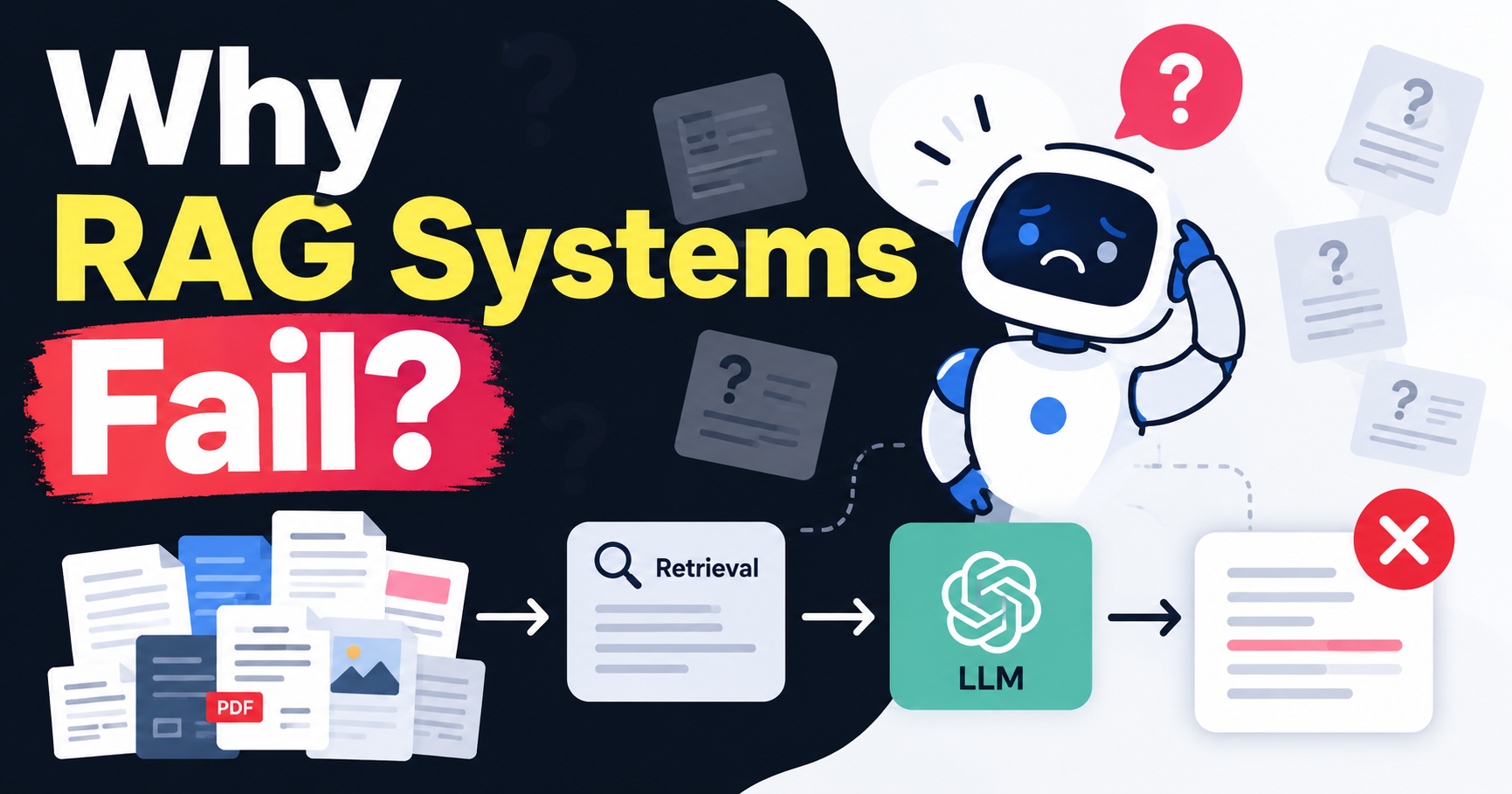
So many people are building rag systems but when it go to users it wil break and you know why ? Here are the 5 main reasons :
1. Poor Data Quality and Document Chunking
A RAG system depends on the data we give it to it. If the data is incorrect, outdated, or incomplete, the system may give wrong answers. Before storing documents, we need to make sure the data is clean and useful. Another important thing is document chunking. Chunking means breaking large documents into smaller pieces. For example, imagine a 100-page book. Instead of storing the entire book as one piece, we divide it into smaller chunks. If the chunks are too large, they may contain unnecessary information. If the chunks are too small, important information may be missing. Because of this, the RAG system may fail to find the right information. So, clean data and proper chunking are the first steps to building a reliable RAG system. okay we understand data quality and wrong document chunking effects the RAG System now lets go into 2nd reason
2. Bad Retrieval — The System Finds the Wrong Information
What is retrieval? Retrieval means finding the right information from stored documents based on the user's question.
Why does it fail? Sometimes, the RAG system finds information that is related to the question but does not answer it correctly.
Example: Imagine a user asks, "How can I reset my password?" but the system retrieves a document about creating a new account. Both topics are related to accounts, but the information is not useful for answering the question.
What happens next? The LLM receives the wrong information and may generate an incorrect answer, even if the correct information exists in the database.
How can we fix it? We need to improve the retrieval process by choosing suitable search methods, adjusting the number of chunks retrieved, and testing whether the correct information is being found.
Remember: even a powerful LLM cannot give a reliable answer if the RAG system retrieves the wrong information.
3. Missing Context and Low-Quality Embeddings
What are embeddings? Embeddings convert text into numbers so that a computer can understand the meaning of words and sentences and compare them.
Why does it fail? Sometimes, embeddings do not help the system find the most useful information for a user's question. As a result, the system may retrieve information that looks related but does not fully answer the question.
Example: Imagine a user asks, "How can I reduce my cloud storage costs?" The system retrieves information about increasing storage capacity instead of reducing costs. Both topics are about cloud storage, but the information does not match the user's actual need.
What is missing context? Sometimes, a retrieved chunk does not contain enough information to understand the complete meaning. For example, a chunk may say, "It reduces the cost by 30%," but it does not explain what "it" refers to.
How can we fix it? We can improve embedding models, test different models with real questions, and make sure each chunk contains enough information to explain its meaning.
Remember: A RAG system needs to understand what the user is asking and retrieve enough meaningful information to answer correctly.
4. LLM Hallucinations and Poor Answer Generation
What is hallucination? Hallucination happens when an LLM gives false information as if it were true. It may sound confident even when the answer is wrong.
Why does it happen? An LLM generates answers based on patterns it has learned. Sometimes, it misunderstands the question or does not have enough information to give the correct answer.
Example: Imagine a user asks, "What is the refund policy of this company?" The retrieved documents do not contain the refund policy, but the LLM still creates an answer by guessing. This can mislead the user.
What is poor answer generation? Sometimes, the system retrieves the correct information, but the LLM misunderstands it, misses important details, or gives an unclear answer.
How can we fix it? We can instruct the LLM to answer using only the retrieved information. If the information is missing, it should clearly say that it does not know the answer instead of guessing. We should also test the answers with different real-world questions.
Remember: Retrieving the right information is important, but the LLM must also use that information correctly to generate a reliable answer.
5. No Evaluation, Monitoring, or Production Testing
What is evaluation? Evaluation means testing the RAG system to check whether it retrieves the correct information and gives useful answers.
Why does it fail? Many developers test their RAG systems with only a few questions during development. The system may work well in these tests but fail when real users ask different questions.
What is monitoring? Monitoring means checking how the system performs after it is deployed. It helps us find problems such as incorrect answers, slow responses, and high costs.
Example: Imagine a RAG system works perfectly with 10 test questions. After deployment, users ask hundreds of different questions, and the system starts giving incorrect answers. Without proper monitoring, the developer may not even know that the problem exists.
How can we fix it? We should test the system with different questions before deployment and regularly check its performance after deployment. We should also collect feedback, measure answer accuracy, and fix problems when they appear.
Remember: Building a RAG system is not the end of the work. We must continuously test and monitor it to make sure it works well for real users.